All standards
Reading: Literature4th Grade
RL.4.9
Compare and contrast the treatment of similar themes and topics in stories, myths, and traditional literature from different cultures.
For parents
Read myths from different cultures and discuss: 'How does this culture explain the same thing differently?'Free sample questions
- Question 1Classroom adaptation of The Lion and the Mouse — Aesop’s Greek fable tradition; adapted from George Fyler Townsend’s English translation. A lion spared a mouse. Later, hunters tied the lion with ropes. The mouse heard him, gnawed through the ropes and freed him. Classroom adaptation of The Mice That Set Elephants Free — The Panchatantra, a Sanskrit story collection from India; adapted from Arthur W. Ryder’s 1925 English translation. An elephant king agreed to lead his herd around the mice’s home. Later, trappers tied up the elephants. The mice returned the favor by gnawing through the ropes and freeing them. Which comparison is supported by details from both stories?
- Only large animals can help others.
- Small helpers can repay kindness: the mouse frees the lion, and the mice free the elephants.
- Both stories explain the sun’s movement.
- Both large animals refuse to protect the mice.
 Question 2Imagine you read two flood myths. In the first myth, a powerful god sends the flood because people have become unkind. In the second myth, the flood happens because a giant river overflows for many years without stopping. What is the main difference in how these two myths explain why the flood began?
- Both myths explain that water covered the entire land.
- The first myth probably has a hero, and the second one might not.
- The first myth shows the flood as a punishment, while the second shows it as a natural event.
- One myth describes a powerful god, while the other does not.
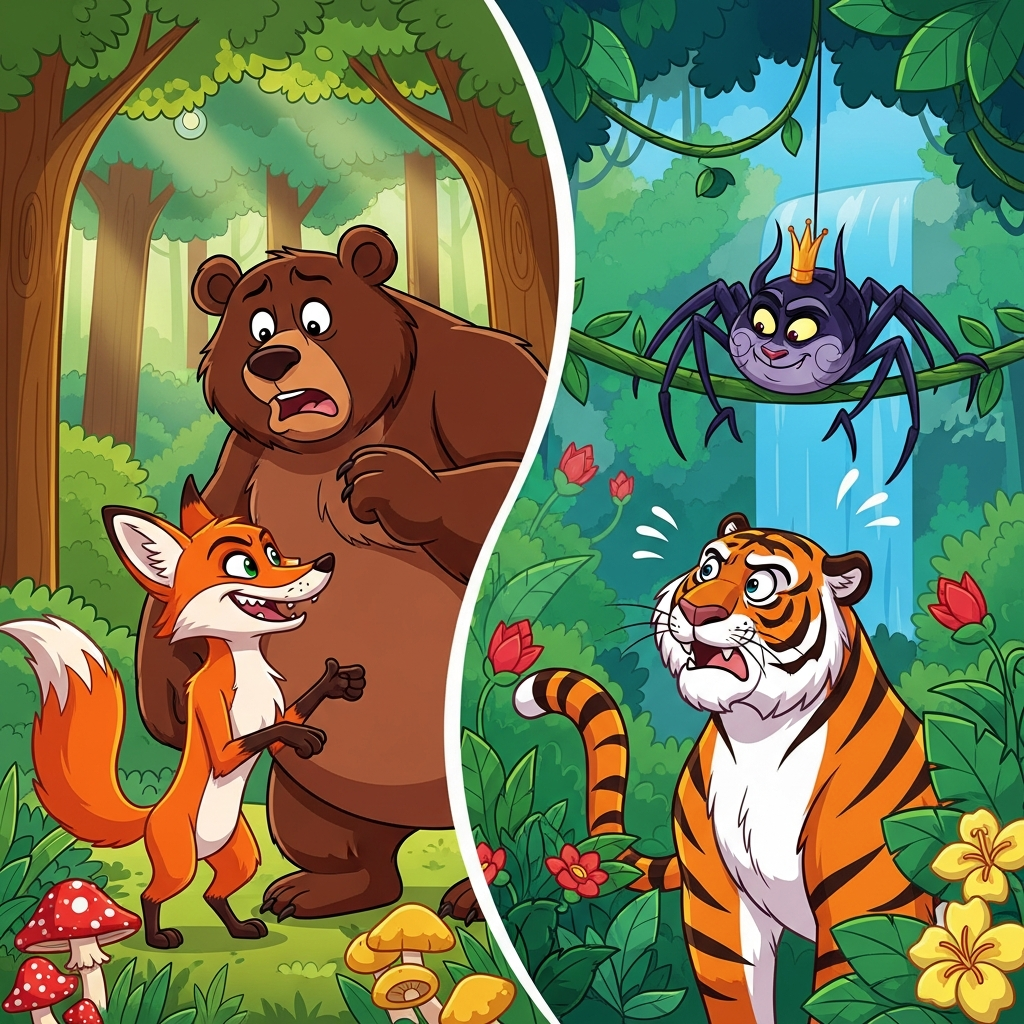 Question 3In a European fairy tale, a small fox uses its wits to outsmart a much larger, stronger animal. In a West African folktale, Anansi the spider, who is not very big, uses clever plans to trick powerful creatures. What main idea do these two stories share?
- Both stories are about animals that live in forests.
- Both stories teach that being smart can help a weaker character win.
- The main characters in both stories are always kind.
- Strong characters always get what they want in both tales.
Unlock 6 more questions for RL.4.9
Readee covers all 911+ K-4 reading comprehension questions aligned to Common Core ELA, with audio read-alouds, comprehension hints, and Science-of-Reading lesson walkthroughs.